
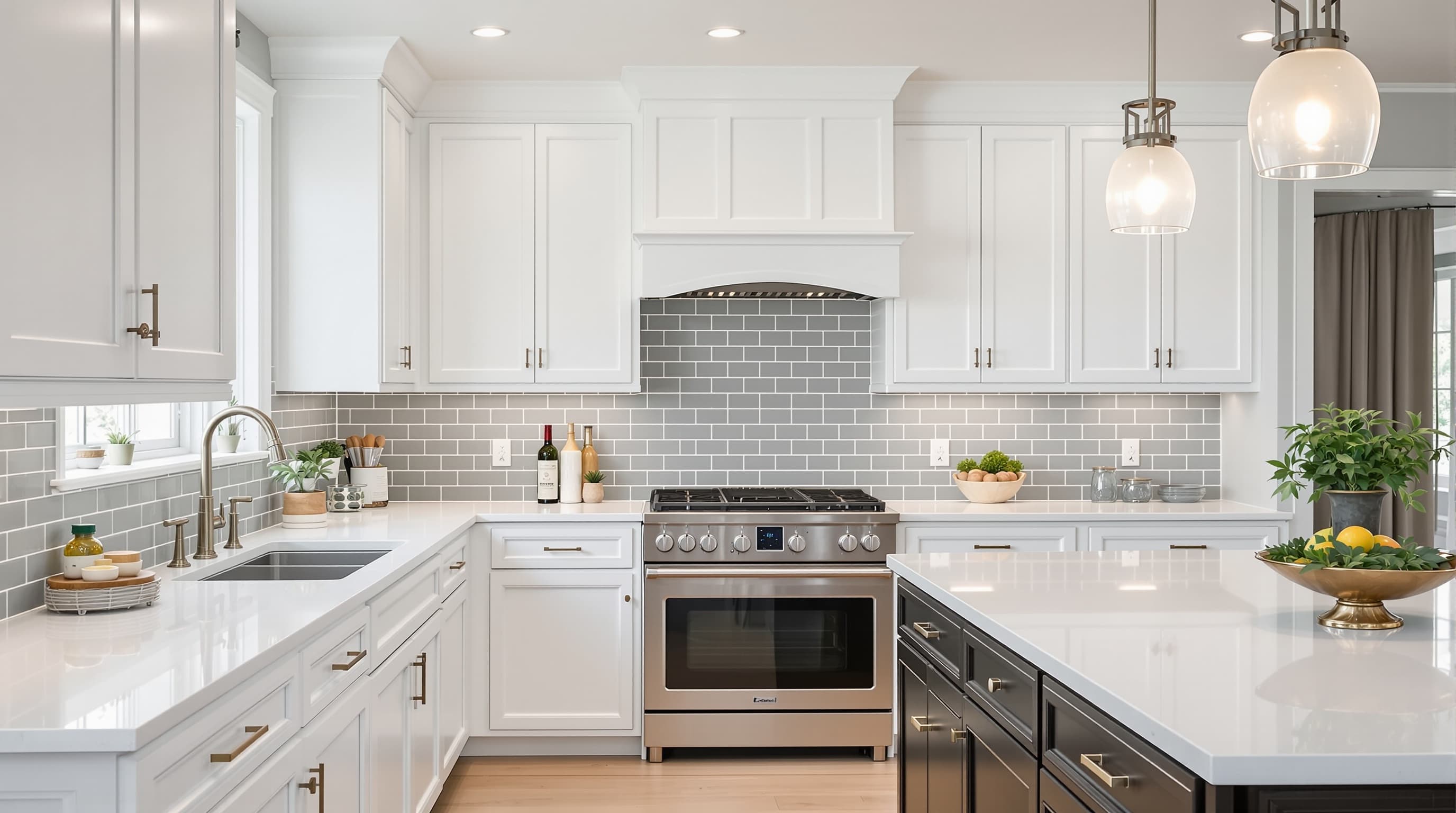
Three paths exist when your kitchen cabinets look tired: paint them, reface them, or tear them out and replace them. On Long Island in 2026, those three options price out at roughly $2,800 / $9,500 / $28,000 for a typical 30-door kitchen. The right answer depends less on money and more on whether the cabinet boxes are structurally sound and whether you like the current layout.
Here’s the honest breakdown — what each option actually is, what it costs, how long it lasts, and when it’s the right call.
Option 1: Cabinet painting (refinishing)
Doors and drawer fronts come off the boxes and go to a dust-controlled spray booth. Boxes stay in place and get hand-brushed or sprayed on-site. Finish coat is a cabinet-grade enamel — Benjamin Moore Advance or Sherwin-Williams Emerald Urethane. Result: factory-smooth color change, hardware stays or gets swapped, layout and boxes unchanged.
- Cost (30-door kitchen): $2,500–$3,800
- Timeline: 5–8 working days (mostly off-site)
- Durability: 8–12 years with proper prep and enamel
- Disruption: Low — kitchen usable through most of the job
- Best when: Boxes are solid wood or good ply, layout works, you want a color change
Option 2: Cabinet refacing
Existing boxes stay. Doors, drawer fronts, and all visible end panels get replaced with new wood or thermofoil. Face frames get covered with matching veneer. New hinges, new pulls. Result: looks like new cabinetry from the outside, but the boxes behind the scenes are your existing 20-year-old boxes.
- Cost (30-door kitchen): $8,500–$12,500
- Timeline: 3–5 working days on-site
- Durability: 15–20 years (material-dependent)
- Disruption: Medium — kitchen closed 3–5 days
- Best when: Boxes are solid but you want new door style and material, not just new color
Option 3: Full replacement
Everything comes out — boxes, doors, hardware. New cabinetry installed. Often paired with new counters, new backsplash, and layout changes. Real kitchen remodel money.
- Cost (30-door kitchen, mid-grade): $18,000–$45,000+
- Timeline: 4–8 weeks (permits, demo, install, finish)
- Durability: 25+ years
- Disruption: High — kitchen unusable for weeks
- Best when: Boxes are rotted/water-damaged, layout is wrong, you’re doing a full kitchen remodel anyway
Side-by-side decision framework
When painting wins
- Boxes are structurally sound (no water damage, no warping, doors still hang straight)
- Door style is acceptable — you just want a color change
- Budget is $2,500–$4,000
- You plan to live in the house 5–10 more years
- You love the layout
Painting is the right answer for roughly 70% of Long Island kitchens we get called to evaluate. Most cabinet boxes from 1990–2010 — even builder-grade oak — are structurally fine. The issue is the orange-stained oak look, not the cabinet itself.
When refacing wins
- Boxes are sound, but you want a different door style (shaker instead of raised-panel, slab instead of shaker)
- You want a wood grain look that painting can’t deliver (rift-sawn white oak, walnut veneer)
- Budget is $8,000–$13,000 and full replacement isn’t worth it
- Layout works — you’re not moving the sink or the range
Refacing is a narrower use case than most homeowners realize. If you want a color change, painting is cheaper and equally durable. If you want a new layout, refacing doesn’t help you.
When replacement wins
- Boxes are damaged (water damage, rot, collapsing shelves)
- Layout is wrong and you want to move walls, islands, or appliances
- You’re doing a whole-kitchen remodel with new counters, floor, and appliances anyway
- Budget supports $25,000+
- You want full custom cabinetry (inset doors, beaded face frames, custom inserts)
Painting cabinets — what the job actually looks like
Here’s the actual sequence on our Long Island cabinet jobs:
- Day 1: Walk the kitchen. Number every door and drawer front with blue tape. Remove all doors, drawer fronts, hardware. Bag hardware by door number. Haul doors to our spray shop.
- Day 2: Degrease boxes with TSP substitute. Sand all surfaces with 220-grit. Vacuum dust. Mask floors, counters, appliances. Prime boxes with Sherwin-Williams Extreme Bond or Stix adhesion primer.
- Day 3: Two coats Advance or Emerald Urethane on boxes, brushed. At the shop, doors sprayed with three thin coats — back first, then front.
- Day 4–6: Doors cure in the shop. Boxes get light sand between coats.
- Day 7: Doors and drawer fronts return. Rehang with original or new hardware. Final punch list.
Proper enamel needs 7–14 days to reach full hardness. We tell customers to be careful for the first two weeks — no slamming, no pressure-cleaning. After that, it’s a durable factory finish.
Color trends we see on Long Island kitchens
- White Dove (OC-17): The safe bet. Reads warm, photographs well, never out of style.
- Simply White (OC-117): Slightly cooler alternative. Good with gray floors.
- Chantilly Lace (OC-65): True clean white. Best with natural wood counters or shaker doors.
- Hale Navy (HC-154): Dark navy on lowers, white on uppers. Two-tone kitchens are popular 2023–2026.
- Soft Fern, Saybrook Sage, Flora: Sage greens trending on North Shore Colonials.
- Black or near-black uppers: Richer, modern look. Tricolette or Black Beauty.
Common cabinet painting mistakes
Rolling instead of spraying doors
A rolled door shows roller stipple forever. You can’t get factory-smooth with a roller. Either spray off-site in a booth, or don’t take the job.
Using latex wall paint
Regal Select or SuperPaint on cabinet doors fails in a year. They aren’t formulated for cabinet wear. Cabinets need a waterborne alkyd (Advance) or a urethane-modified acrylic (Emerald Urethane).
Skipping the degrease step
Kitchen cabinets have invisible grease on every surface — the 15-year fog of cooking residue. Paint over grease and you get fish-eyes, peeling, adhesion failure. TSP substitute, then rinse, then sand.
Ignoring MDF edges
MDF doors have raw edges that wick water. If the door is MDF (most thermofoil doors are), every edge needs a shellac primer (Zinsser BIN) before topcoat. Skip it and the edges swell within a year.
How to pick between painting and refacing (the practical test)
Open a cabinet door. Look at the door style. If you could live with this door style in a different color, paint. If the door style itself is the problem (raised-panel oak, thermofoil, 1980s vibes you can’t unsee), reface.
Look at the boxes. Pull out a drawer. Put weight on a shelf. Tug a hinge. If any of those things feel structurally compromised, you’re probably replacing, not painting or refacing.
The bottom line
Most Long Island kitchens we see are solid candidates for a professional paint job. For $2,800–$4,000 you get a factory-smooth color change that lasts a decade. Refacing makes sense if you want a new door style without moving walls. Replacement is only worth the money when the boxes are failing or the layout needs to change.
Pay for real cabinet enamel, pay for off-site spray, pay for proper prep. Skip any of the three and you’re back on the market in two years.