Exterior paint fails for two reasons: bad prep, or bad product. Everything else — weather, siding type, color — matters, but prep and product are 95% of the equation. If you do both right, your Long Island exterior paint job lasts 10–15 years. If you cut either one, it fails in 3.
Timing — the Long Island weather windows
Long Island gives us two legitimate exterior painting windows a year:
- Spring window: Mid-April to late June. Temperatures warm, humidity still manageable.
- Fall window: Mid-September to late October. Humidity drops, dew points behave.
We do not paint exterior in July and August if we can avoid it. Here’s why: at 85%+ humidity, waterborne paint can’t cure properly. The surface skins over but the underlying film never cross-links. The result looks fine the day it goes on and starts chalking within 18 months.
The real prep sequence
Day 1: Pressure wash
Low-PSI wash (1,200–1,800 PSI) for painted surfaces. Higher for stucco, lower for cedar shake. Bleach solution on mildew. Full 24–48 hour dry time before anything else happens. Wet paint over damp siding is the #1 cause of exterior paint failure on Long Island.
Day 2–3: Scrape, sand, caulk, prime, repair
- Hand-scrape every area of failed paint
- Feather-sand the edges smooth with 80–120 grit
- Caulk every seam, joint, and trim-to-siding line with 25-year paintable acrylic caulk
- Cut out rotted wood, replace with PVC or primed pine, prime before topcoat
- Spot-prime every bare wood area with oil-based primer (Zinsser Cover Stain or Sherwin-Williams Exterior Oil Primer)
- On cedar — full-prime with oil-based tannin-blocking primer
Day 4–6: Paint
- Two coats premium acrylic on siding
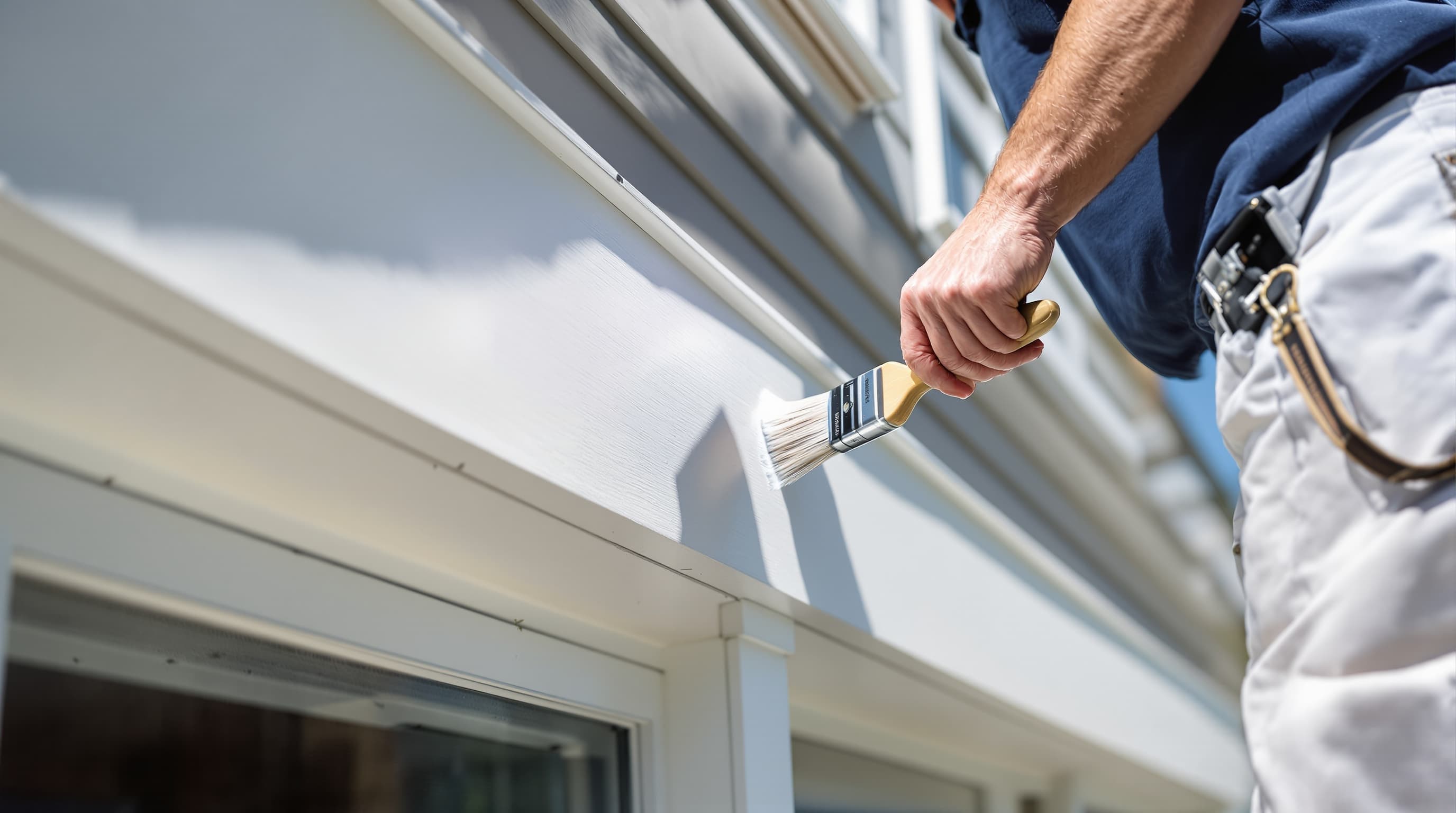
- Hand-brushed trim for crisp lines (spray rigs produce mil too thin for window sashes)
- Shutters pulled off the house, sprayed off-site, reinstalled after cure
- Doors brushed or sprayed per customer preference (sprayed looks better; brushed is more forgiving)
Best exterior paint for Long Island
- Sherwin-Williams Duration: Our default exterior. Great self-priming, 10–15 year life on siding, excellent color retention.
- Sherwin-Williams Emerald Exterior: Step up from Duration. Better UV resistance and flexibility. Specify for south-facing walls.
- Sherwin-Williams SuperPaint: Budget option. Not as durable as Duration but better than anything at the box store.
- Benjamin Moore Aura Exterior: Premium tier. Best mildew resistance. Our coastal default — Great Neck, Huntington Harbor, Babylon South Shore.
Siding-specific systems
Cedar shingle (North Shore staple)
Cedar bleeds tannin through waterborne paint within weeks. Always oil-prime first — Zinsser Cover Stain is our default. Then breathable acrylic topcoat. Two coats. Solid stains are an alternative that lets the texture show through; full paint covers more completely.
Vinyl siding
Yes, you can paint vinyl — but only with vinyl-safe paint (Sherwin-Williams VinylSafe or Benjamin Moore’s vinyl-safe palette). Dark colors absorb heat and warp vinyl unless the formula is engineered for it.
Hardie board / fiber cement
Hardie takes paint beautifully. We prime with an acrylic bonding primer on bare Hardie, or go straight to topcoat if the factory finish is intact but faded. Two coats Duration is standard.
Stucco
Stucco needs elastomeric paint or a breathable acrylic formulated for masonry. We use Sherwin-Williams Loxon or Benjamin Moore Moorlastic depending on crack severity. Hairline cracks get caulked and textured before topcoat.
Coastal homes — the extra step
On every coastal Long Island home (within 1 mile of the water), we add a second topcoat on the south and east windward-facing walls. Salt air breaks down cheap paint and even premium paint faster on the exposed sides. Two extra gallons of paint, one extra day of labor, five extra years of paint life.
Warranty — what to ask for
- Written workmanship warranty from the contractor (3–5 years standard)
- Manufacturer product warranty registered in your name
- Licensed and insured documentation with your estimate
- EPA RRP certification if your home is pre-1978
What a proper exterior estimate looks like
Every line itemized. Prep scope named. Paint product specified by name and sheen. Number of coats stated. Rotted wood repair priced separately. Warranty in writing. Two pages, not one line. If you get a one-line quote, you’re getting a guess — not a plan.