
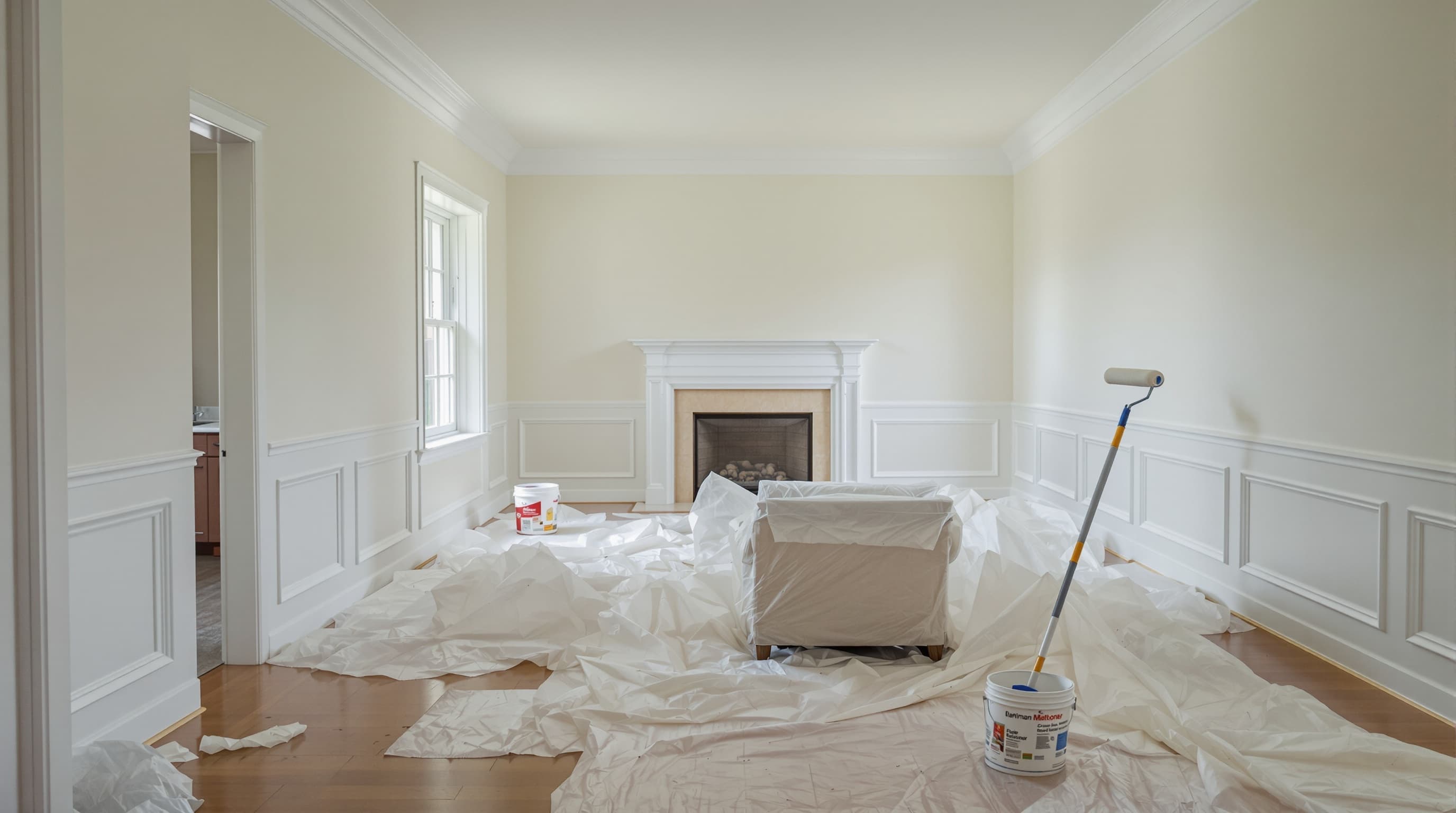
Every interior paint job lives or dies on prep. The finish coat — the part the homeowner sees — is 20% of the work and 100% of the visible result. Skip prep and your $7,500 interior job looks like a $1,500 interior job in six months. This is the guide we use ourselves, step by step.
Step 1: Walk the job, write the scope
Before any paint goes on, walk every room with a flashlight. Note every nail hole, every hairline crack, every area of glossy trim that needs sanding, every spot of water staining on the ceiling. A proper interior scope has a room-by-room line item. If your painter didn’t write one, they won’t do one.
Step 2: Move and mask
- Furniture moves to the center of the room or an adjacent space
- Everything gets covered with drop cloths or plastic
- Floors get masked edge-to-wall with rosin paper or canvas
- HVAC vents sealed with blue tape to prevent dust migration
- Switch plates, outlet covers, curtain rods — all removed, not painted around
- Light fixtures loosened and bagged
This takes the first half of day one. Shortcut it and you’ll find paint drips on hardwood a week after the painters leave.
Step 3: Patch every hole, skim-coat as needed
Nail holes get filled with spackle (lightweight for small, setting-type for large). Cracks at the ceiling line get scored, taped with paper tape, and skim-coated twice with joint compound. Larger damage (water stains, popped drywall tape) gets Level 4 or Level 5 patching — a progressively wider skim coat, sanded flat, primed.
Step 4: Sand every glossy surface
New paint doesn’t stick to glossy paint. Sanding breaks the sheen and gives the next coat something to bite into. Trim, doors, and any semi-gloss walls all need a light scuff with 150–220 grit before primer or paint. HEPA-vacuum the dust as you go — don’t let it settle in the HVAC.
Step 5: Caulk every gap
Every seam between trim and wall, every crown-to-wall joint, every baseboard gap gets caulked with paintable acrylic latex caulk. This is the step that separates a $4,000 interior from a $7,500 interior. The caulked lines read as perfect straight lines to the eye, even when they’re not.
Step 6: Prime bare surfaces and repairs
- Drywall patches: PVA primer or Zinsser 123
- Water stains: Zinsser BIN shellac-based primer (only thing that blocks them)
- Bare wood trim: Zinsser Cover Stain oil primer
- Oil-painted trim transitioning to water-based: Sherwin-Williams Extreme Bond or Ben Moore Stix
- Tannin woods (cedar, redwood): Oil-based primer — always
Step 7: Paint — ceilings first, walls second, trim last
Sequence matters. Ceilings get cut and rolled first (flat ceiling paint — Benjamin Moore Waterborne Ceiling or Sherwin-Williams ProMar Ceiling). Then walls (Regal Select matte or eggshell on most walls, Aura for high-traffic and kitchens/baths). Trim last (Advance satin or semi-gloss, hand-brushed for crisp lines).
Two coats. Always two coats.
Anyone who tells you “one-and-done” on a color change is cutting corners. One coat flashes — it shows different sheens in raking light. Two true coats over primer is the minimum. Dark-to-light color changes often need three.
Step 8: Punch list and cleanup
Walk the job with the customer. Mark every touch-up on blue tape. Hit them that afternoon — not next week. Remove masking, re-install switch plates and outlet covers, re-hang fixtures. Vacuum. The job isn’t done until the house is cleaner than when you arrived.
Paint brands we specify and why
- Benjamin Moore Regal Select: Workhorse wall paint. Great coverage, easy to touch up, 20+ custom sheens.
- Benjamin Moore Aura: Premium tier. Better scrub resistance, richer color depth. Specify for kitchens, baths, high-traffic.
- Benjamin Moore Advance: Waterborne alkyd for trim and doors. Levels like oil, cleans up like latex. Slightly slow dry time, worth it.
- Sherwin-Williams Emerald Interior: Matches Aura for quality. Our second-choice wall system.
- Sherwin-Williams Emerald Urethane: Cabinet-grade enamel. Factory-smooth when sprayed.
Color selection — the professional approach
Pick your whites last. White is the hardest color to choose because it reads differently in every light. We always sample three whites on three walls of every room — morning light, afternoon light, artificial light. Benjamin Moore OC-17 White Dove, OC-45 Swiss Coffee, and OC-117 Simply White are the three we end up with most often on Long Island.
For accent walls and statement rooms, sample 2’×2’ swatches — not the 9×9 paint chips from the store. Color reads completely differently at scale.
Common interior painting mistakes we see
- Painting over glossy trim without sanding (fails in 6 months)
- Skipping primer on new drywall (blotchy finish)
- One coat on a dark-to-light color change (ghosting)
- Cheap caulk (cracks within a year)
- Box-store contractor-grade paint (chalky, doesn’t level)
- Painting in cold rooms < 55°F (paint crawls)
How long an interior repaint takes
- Single room: 1–2 working days (including prep and second coat dry time)
- Full floor (4 rooms): 4–5 working days
- Whole house (8–12 rooms): 6–10 working days
- High-end Level 5 + cabinet + trim: 3+ weeks
We work in clean blocks — 2 or 3 rooms at a time — so the homeowner isn’t living in a construction zone for a month.